OLYMPUS DIGITAL CAMERA
©

OLYMPUS DIGITAL CAMERA

|

Ville de Dunkerque

Jean Bart The Sun King’s Privateer

The Sun King’s Privateer

Jean Bart… The people of Dunkirk have erected a statue in his honour and even written a song about him. But how well do you really know him?

Discover the life and exploits of Dunkirk’s famous privateer.

The Birth of a Hero

Jean Bart, born on 21 October 1650, came from a family of privateer shipowners.

At the age of 12, he became a cabin boy. He learned the trade aboard a coastal patrol brigantine, an experience that allowed him to memorise the contours of the Dutch, Scottish, Irish, English and French coasts.

At 16, he joined the Dutch navy, France’s ally at the time, aboard the finest vessel in the Dutch fleet, De Zeven Provinciën.

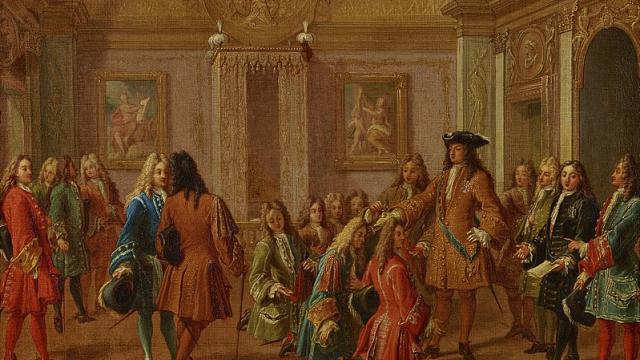
At 23, when war broke out between France and the Netherlands, Jean Bart chose his side: he returned to Dunkirk! Accompanied by his friend Charles Keyser, he took command of a privateer vessel. His bravery soon caught the attention of Colbert and Vauban and was rewarded by Louis XIV himself.

The privateer became a captain!

Jean Bart’s Escape

Jean Bart made a name for himself through a remarkable escape and unwavering courage!

While privateering alongside Captain Claude de Forbin, the two privateers were escorting merchant ships when they were pursued by English vessels. Wounded, they were taken to a prison in Plymouth, England, in early June 1689.

A sailor brought them a file to saw through the bars of their cell. The surgeon treating their wounds also helped them and asked to accompany them back to France in return. After eleven days in captivity, Bart and Forbin escaped aboard a simple rowing boat, accompanied by two cabin boys and the surgeon.

Jean Bart took the oars himself and did not stop until they reached Brittany. Their 60-league journey (around 290 km) took less than forty-eight hours.

Jean Bart’s exploits soon reached the court of Versailles!

The Battle of Texel

How Jean Bart Saved France from Famine

A famine broke out between 1692 and 1694, and is considered the deadliest famine of the 17th century.

Jean Bart’s new mission was to feed France by escorting 120 merchant ships from Norway to Dunkirk.

On 29 June 1694, the French ships approached the island of Texel. The crew spotted their convoy being captured by the Dutch. Jean Bart summoned the captains aboard his ship to devise a strategy and declared:

“We must fight and recapture the fleet, or die trying.”

Boarding!

The privateer’s strategy was not to use artillery, but to board the enemy ships! The battle lasted only around thirty minutes, but it was bloody, and the French emerged victorious.

The Dutch rear admiral was mortally wounded and, before he died, declared: “My consolation is that I was defeated by heroes.”

The outcome: 16 Frenchmen were killed and 50 wounded, compared with more than 300 Dutch casualties.

The French victory at the Battle of Texel brought the price of wheat down from 30 to 3 livres tournois. Jean Bart had just saved France from famine.

From Promotion to Knighthood

THE DEATH OF JEAN BART

Jean Bart died of pleurisy on 27 April 1702, at his home, at the age of fifty-two.

As tradition required, the streets of Dunkirk were covered with straw from the deceased’s home to Saint-Éloi Church. His funeral was a grand affair, with cannon fire ringing out across the city. He was then laid to rest at the foot of the church’s high altar.

His death was mourned throughout the nation, which had lost one of its great heroes. Even the Dutch and the English paid their final respects before celebrating the loss of their greatest enemy!

Did you know?

1928 – Following excavations carried out in the church, Dr Louis Lemaire discovered the remains of the famous privateer. He is estimated to have been 1.90 metres tall. The local authorities decided to replace his coffin.

Before being reburied, the sailor’s remains were displayed in a glass coffin for eight days inside the church.

He now rests at the foot of the high altar in the choir of Saint-Éloi Church.

The Jean Bart Statue

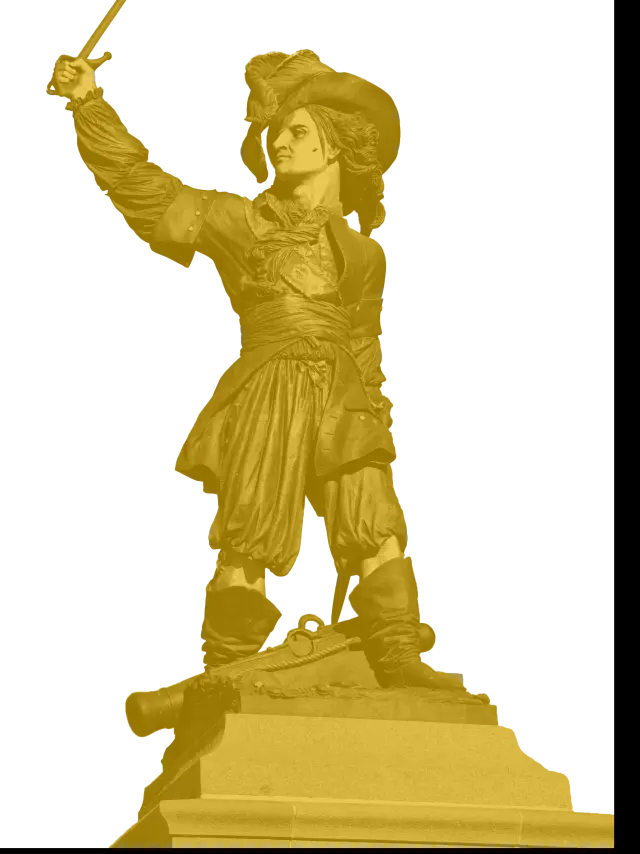
The Jean Bart statue was unveiled on 7 September 1845. It was created by sculptor David d’Angers and cast by the Parisian foundry Eck et Durand.

Standing eight metres high including its pedestal, it depicts “Jean Bart leaving his ship, stepping over the cannon of an enemy vessel he has just boarded, and turning back towards his sailors to rally them.”

In 1838, when a municipal committee met to discuss the project, the city did not have the means to fully fund the statue.

The foundry workers and the artist therefore waived their fees and worked for free.

It took two years to raise the funds needed to cover the cost of the materials. The people of Dunkirk themselves contributed 25,000 francs.

The Cantata to Jean Bart

First performed in 1845 for the inauguration of his statue and dedicated to Admiral Prince de Joinville, the cantata was performed by two hundred singers.

To this day, the cantata is still sung during the final rigodon of the Dunkirk Carnival. Gathered around the statue, on their knees with their arms raised to the sky, carnival-goers pay tribute to his memory.

cantate-a-jean-bart-video-paroles-des-3-couplets.mp3CANTATE A JEAN BART (vido) (Paroles des 3 couplets) par moudr'. Date de sortie : 2019.

Did you know?

 Le premier personnage civil

Jean Bart was the first civilian figure to be represented in a public space in Dunkirk, with a bust erected in 1806 on Place Dauphine, now Place du Général de Gaulle. Unfortunately, the bust was damaged and is now kept in storage.

 Jean Bart toujours debout

Traces of the Second World War can still be seen on the bronze: a shell fragment from 1940 damaged the edge of his sword, while a bullet impact dating from May 1945 can be seen on his left cheek.

Our famous privateer inspired the character Jean Bart in the One Piece manga, who is also a pirate and a captain.

 Jean Bart dans le quotidien des dunkerquois

Today, a street, a high school and many local businesses bear his name. His image can be found on shop signs, windows, street lamps and even building façades.

The Vandewaelle pastry shop – Aux Doigts de Jean Bart – on Rue du Sud has created a pastry in his honour. It is an almond cake filled with coffee cream and coated in chocolate.

A must-try Dunkirk speciality that has even made its way to Japan!

Bibliographie 

DUQUESNE, J. Jean Bart. Paris: Éditions du Seuil, 1992.

LEBON, E. Le fondeur et le sculpteur: Technique du bronze et histoire de l’art. Paris: Publications de l’Institut national d’histoire de l’art, 2012.

MALO, H. “Les Origines de Jean Bart.” Revue Historique, 1914, pp. 55–63.

VERCEL, R. “Deux Corsaires et une ville II: Jean Bart.” Revue des Deux Mondes (1829–1971), 15 April 1943, pp. 337–353.

—. “Deux Corsaires et une ville III: Jean Bart.” Revue des Deux Mondes (1829–1971), 1 May 1943, pp. 63–75.

VILLIERS, P. Jean Bart: Corsaire du Roi-Soleil. Paris: Fayard, 2013.

Contents : Elisa LEMAITRE